Model Context Protocol (MCP) – The new protocol that helps LLMs… stop being “goldfish-brained”? 🧠🐟
As AI gets smarter, context memory becomes increasingly important.
But did you know that most LLMs today still often forget who they’re talking to, why, and for what purpose?
💡 What is MCP?
Model Context Protocol (MCP) is an open protocol developed by Anthropic (Claude AI) to solve one big problem:
How can LLMs share context efficiently with external data sources?
Imagine this:
You have LLM A (Claude, GPT, Gemini…)
You have data scattered across Google Drive, Slack, Notion, CRM, and internal APIs
You want your LLM to use the right data, in the right context, without prompt hacks
➡️ MCP is like the “USB-C standard” for connecting everything smoothly.
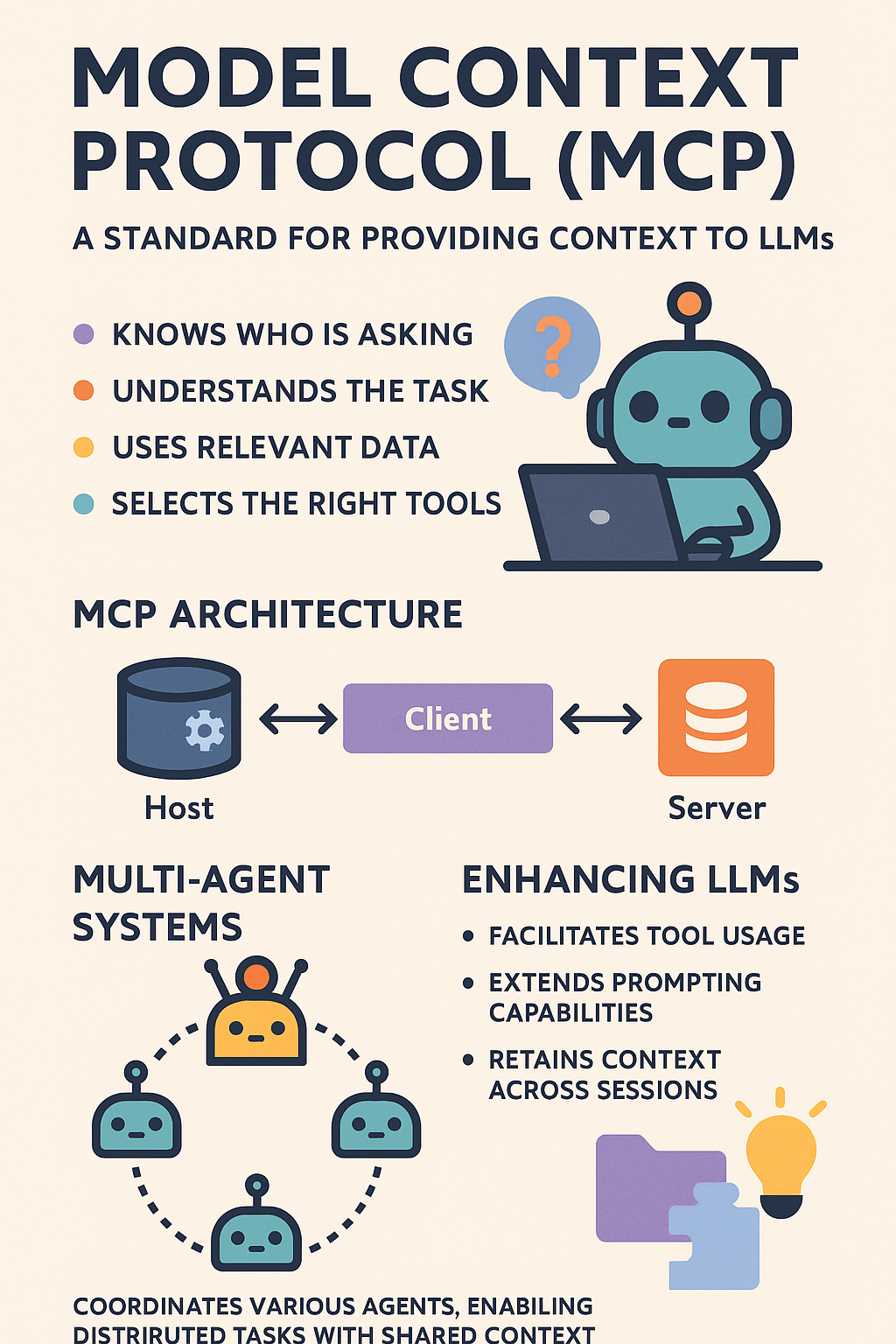
🧱 MCP Architecture – simple yet remarkably elegant
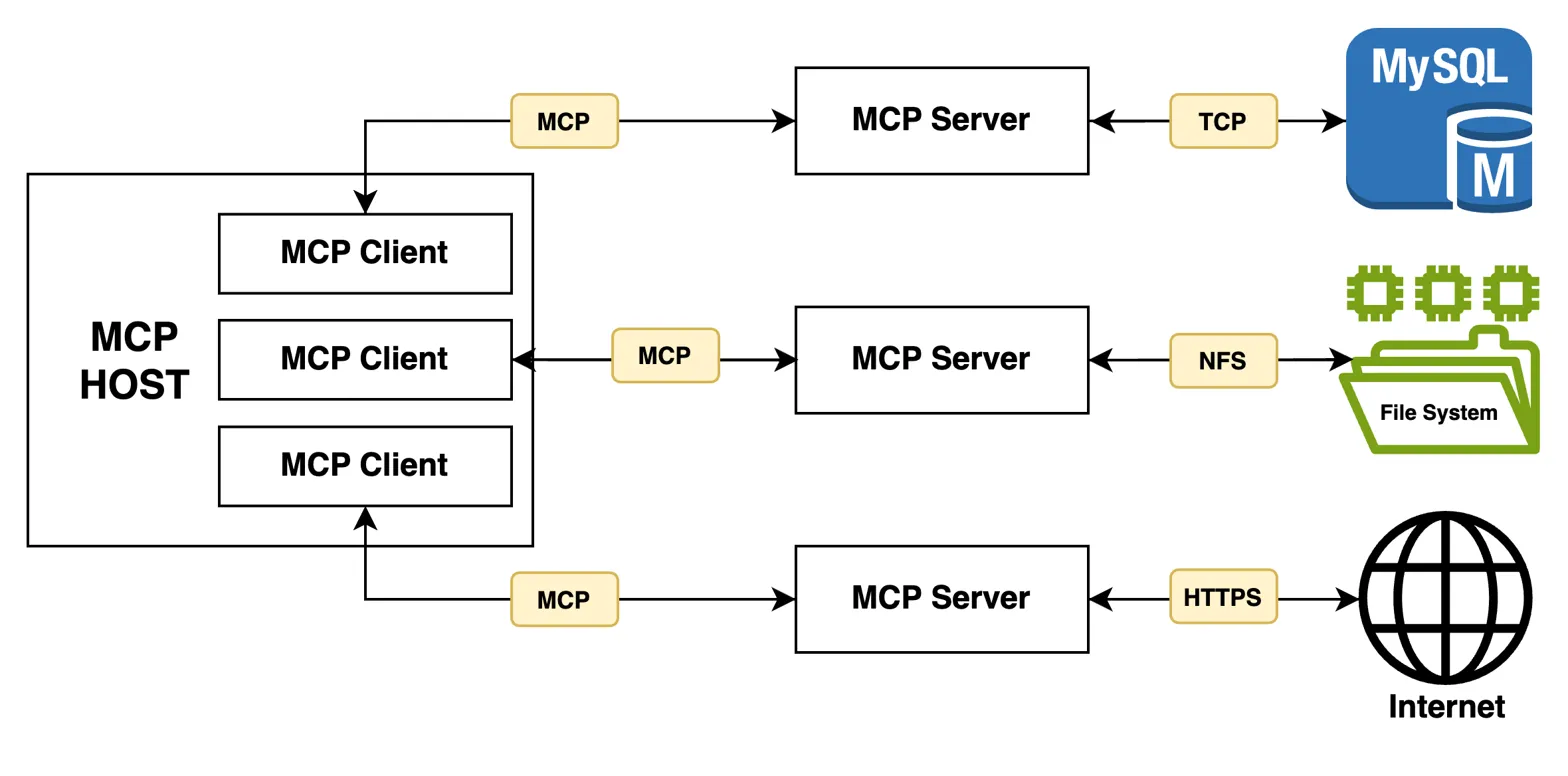
MCP defines three core components:
- Host: The main application — holds the overall context and orchestrates logic
- Client: The bridge between the host and data sources/tools
- Server: Each server provides a specific data or function (e.g., read files, call APIs, query databases)
➡️ Each LLM doesn’t “see everything” — it only receives the exact context needed, at the right time.
➡️ With its JSON-RPC + session-based + LLM-agnostic design, MCP ensures security, flexibility, and transparent debugging.
🤖 Perfect for Multi-Agent Systems
MCP is ideal for modern AI setups where:
- One coordinator agent manages multiple specialized sub-agents
- Each sub-agent focuses on one task — search, analysis, reporting
- Every agent has its own context, unified under a single host
Example: Claude AI can spin up four agents in parallel to gather data from different sources, then merge the results into a single report — all coordinated through MCP.
⚙️ Smarter LLM Integration — Beyond RAG
MCP doesn’t replace RAG — it enhances it.
It helps:
✅ Select the right tool and data source (RAG-MCP hybrid)
✅ Reduce “prompt overload” when multiple tools are connected
✅ Seamlessly switch between LLMs (Claude → GPT → Gemini) without rewriting connectors
You can use MCP to:
- Build AI systems that search files, extract metrics, and make decisions
- Integrate into IDEs so AI understands project context and calls the right dev tools
- Create personal assistants that reason continuously across sessions
✅ Benefits for Teams and Businesses
For Technical Leads / Devs:
- Clear separation between logic and data layers
- Easier testing, tracing, and configuration
- Enable agents that reason across multiple steps
For Product / PMs:
- Faster integrations (one standard, many platforms)
- Easy expansion to internal tools or data sources
- More reliable AI with better “long-term memory”
⚠️ Challenges to note
- Requires a well-planned architecture and context classification
- Internal servers need good infrastructure and security management
- “Prompt bloat” can occur if too many tools are used without solid RAG handling
✨ Conclusion
MCP doesn’t make AI smarter —
but it makes AI more organized, contextual, and capable of remembering.
As we move toward a multi-agent, multi-LLM future, protocols like MCP are the key to building AI systems that are:
🧠 Long-term thinkers
💬 Seamlessly communicative
🔗 Standardized, debuggable, and maintainable
📣 Have you tried using MCP or a similar context-sharing framework?
Would you like me to share more about MCP + RAG + Function Calling + LangGraph next?
📎 Sources: Anthropic Docs, Claude Research Team, and the open-spec MCP GitHub.
LLM Engineer Starter Pack — Coming Soon
Build with LLMs. Get early access.